Steinway Tower (111 West 57th Street) Facts and Information
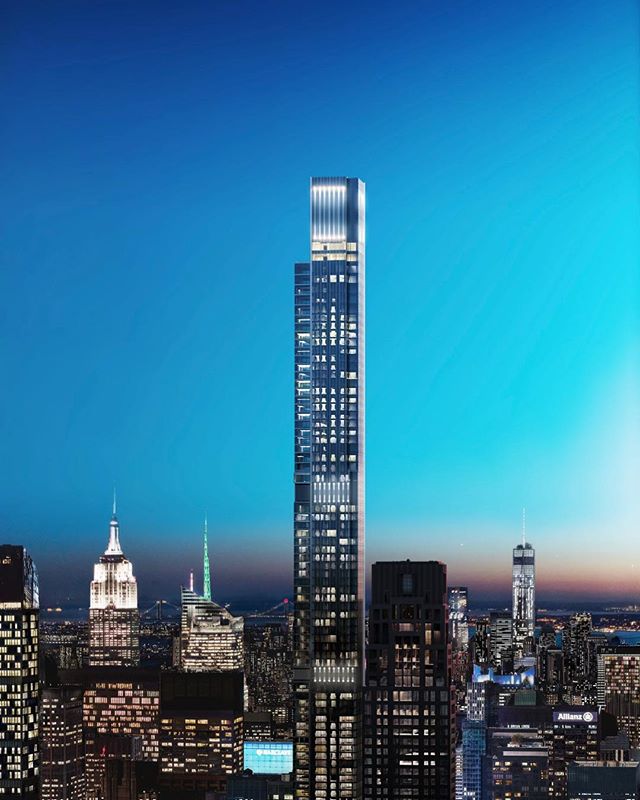
Steinway Tower, also known as 111 West 57th Street, is a supertall residential tower in Midtown Manhattan, New York City. It is known for being the world’s thinnest skyscraper and one of the tallest residential buildings.
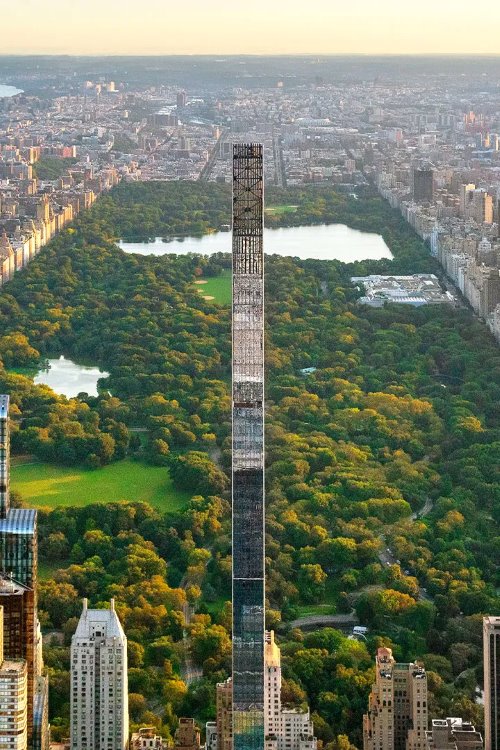
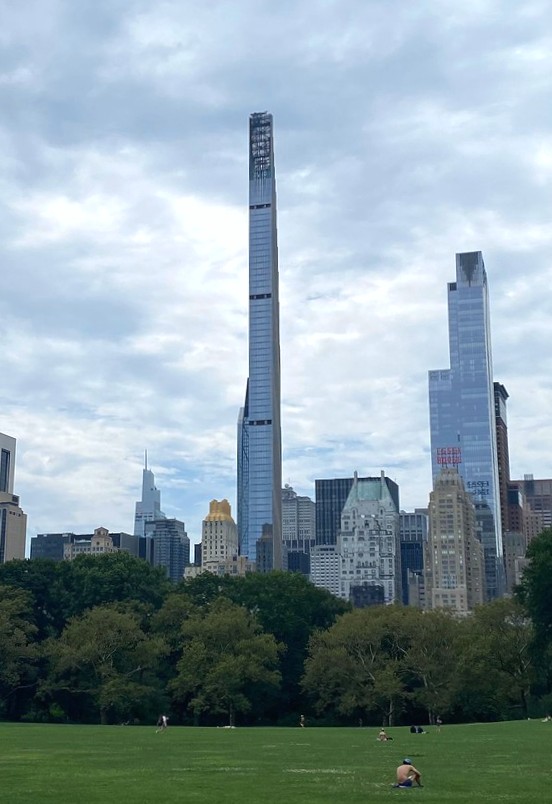
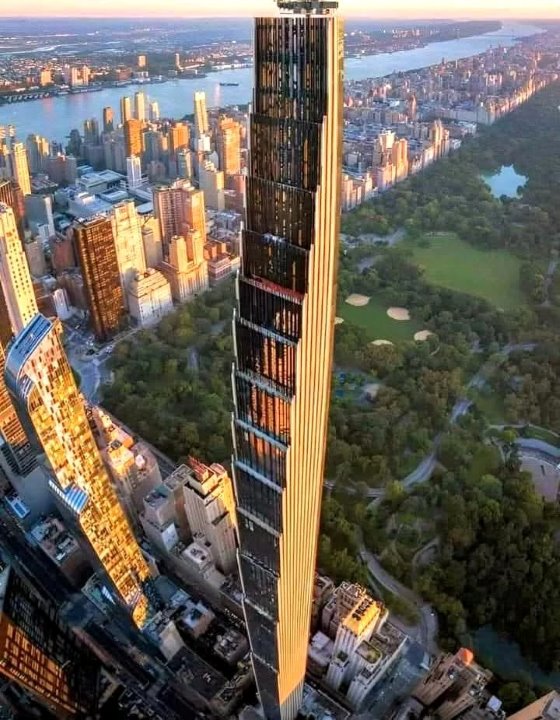
111 West 57th Street, with Central Park in the background
Below are facts and information about the tower.
Location
Steinway Tower is located in Midtown Manhattan, New York City, New York, United States. It is situated one block south of Central Park, on the north side of West 57th Street, roughly at the midpoint of the street, with Sixth Avenue to its east.
Another supertall residential tower, One57, is located on the same block, near the western end of the block, while this tower is closer to the eastern end.
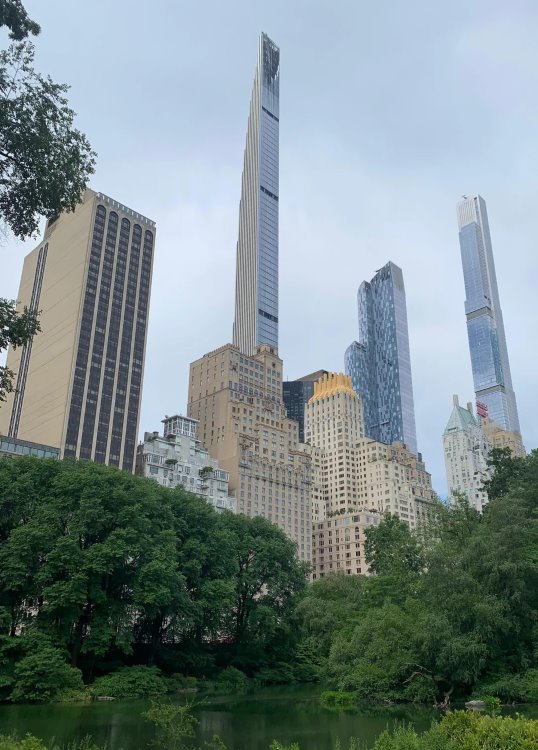
The Steinway Tower seen from Central Park
Directly across the street from the building is the 57th Street station of the New York City Subway’s F and M lines.
At the base of the tower is the original Steinway Hall, a 16-story L-shaped building that wraps around the west and north sides of Steinway Tower’s base. This building originally served as the showroom, concert hall, and offices of Steinway & Sons and was completed in 1925. It is a designated New York City landmark, and its original address was also 111 West 57th Street.
Height
The building rises 84 stories and stands 1,428 feet (435 meters) tall.
As of February 2026, the tower is the 3rd-tallest building in New York City, the 4th-tallest in the United States, and the 28th-tallest building in the world.
The roof slab of the tower is 1,257 feet 6 inches (383 meters) above ground level. Above the roof is a stepped steel framework that does not contain any occupiable space.
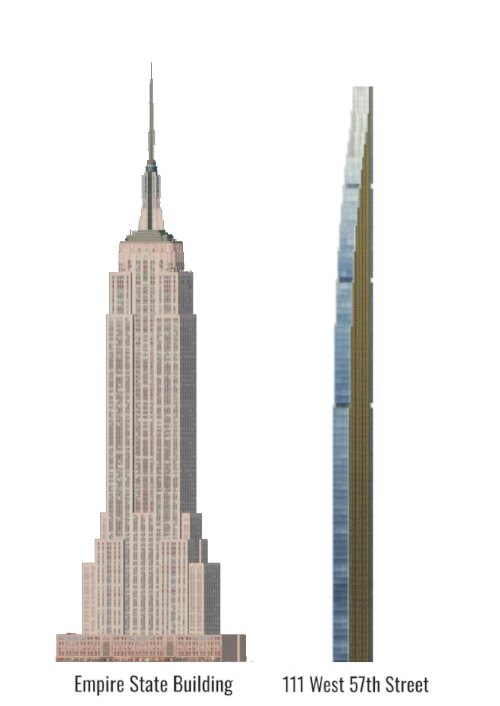
Here is a height comparison between the Steinway Tower and the Empire State Building.
Height comparison between the Steinway Tower and the Empire State Building
Uses
Steinway Tower is a residential building, containing 45 apartments, six of which are duplex units.
The building also offers a wide range of resident amenities, most of which are located in the lower portion of the tower.
The lower floors do not include residential units, as views of Central Park are blocked by neighboring buildings.
Residential units begin above the 17th floor (numbered as the 20th floor), with no more than one apartment per floor. Most units are single-level three-bedroom apartments, but they are significantly larger than typical three-bedroom units. In addition, there are six duplex apartments located on floors 60–61 and 72–83. Among them, floors 80–83 form a five-bedroom quadplex apartment, which was created in 2025 by combining the two original top-floor duplex units. Excluding this combined ultra-large penthouse, apartment sizes range from 3,873 to 7,128 square feet (approximately 360 to 662 square meters).
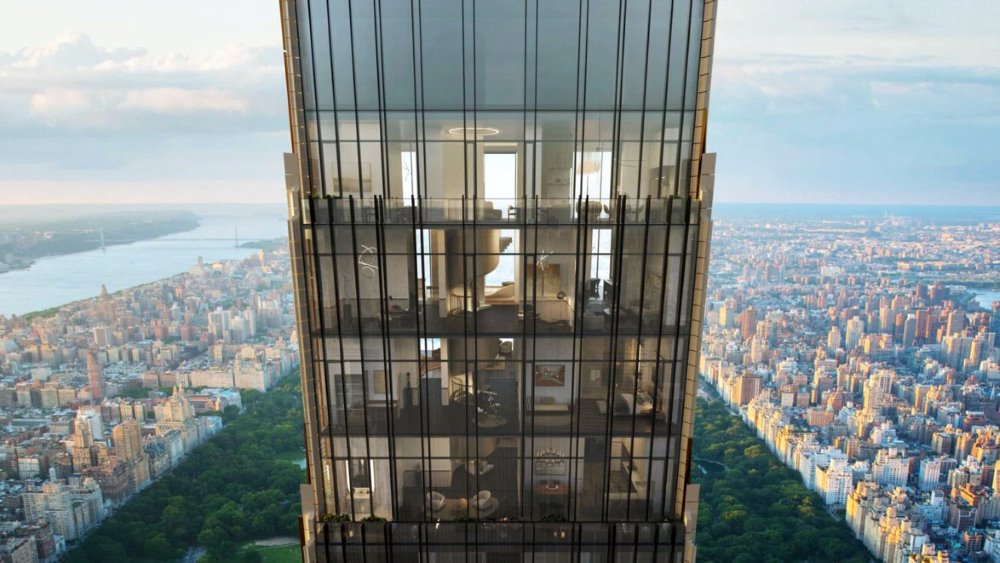
The quadplex on the top of the Steinway TowerAn interior view of the quadplex
The building has two shared elevators serving all residents, connecting every residential floor with the ground floor and the 10th floor. In addition, each duplex apartment is equipped with a private elevator connecting the levels within the unit, for a total of seven private elevators.
Design
Steinway Tower was designed by the New York-based architectural firm SHoP Architects.
The building has an extremely slender form and is widely regarded as one of the defining examples of New York City’s new generation of “pencil towers”.
Steinway Tower and One57 (right) seen from Central Park
The tower occupies a footprint of only 59 feet by 75 feet (18 meters by 23 meters), yet rises to a height of 435 meters, making it the world’s most slender skyscraper, with an approximate width-to-height ratio of 1:24.
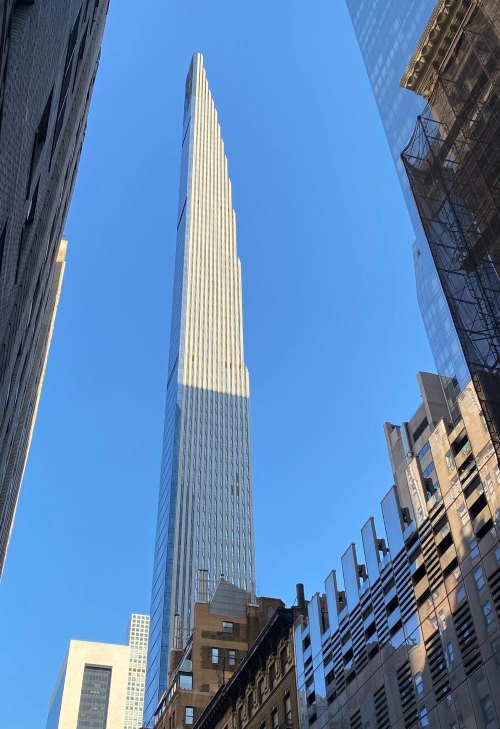
The tower’s north façade rises straight up to the top, while the south façade gradually steps back as the building rises, creating a terraced form near the summit. This shape has earned 111 West 57th Street the nickname “the Stairway to Heaven”.
The “stairway” on the upper part of the Steinway Tower
Both the north and south façades are composed of large glass curtain walls. Bronze vertical mullions are placed between the windows and project slightly from the glass surface.
The east and west façades feature a series of glazed terracotta piers that provide structural support. Narrow windows are set between these piers, arranged in a wave-like pattern.
West façade of the Steinway Tower
The building has 84 above-ground floors, with a typical floor-to-floor height of approximately 4.3 meters (14 feet). The top floor is numbered as the 91st floor, while floors 5–7, 13, and 21–25 are skipped in the numbering. The highest occupied residential floor is located 1,134 feet (346 meters) above ground level.
The tower’s crown is inspired by the crown of the Chrysler Building. It is a tapering, stepped steel framework that contains no residential space but defines the building’s final silhouette and official height. The crown sits on a platform made of metal composite panels and is reinforced with steel beams; it also houses part of the building’s mechanical equipment. At the top of the tower is an 800-short-ton (730 metric tons) tuned mass damper, which enhances the building’s resistance to strong winds and seismic activity.
The tower’s foundation includes nearly 200 steel-reinforced piles, extending as deep as 100 feet (30 meters) into the bedrock. Normally, New York City skyscrapers do not require such deep foundations due to the city’s favorable geology; however, the extreme slenderness of this tower made a deeper foundation necessary. The building includes two basement levels used for storage.
Development
Steinway Tower was jointly developed by JDS Development Group and Property Markets Group.
In late 2012, Steinway & Sons announced that it would sell Steinway Hall. In March 2013, a joint venture consisting of JDS Development, PMG, and Arthur P. Becker officially acquired Steinway Hall. In July 2013, JDS purchased the land on which Steinway Tower stands, along with adjacent buildings and air rights, for $131.5 million.
A groundbreaking ceremony was held in early 2014. Later that year, excavation work began on the extremely constrained site.
In January 2015, the New York City Department of Buildings approved the project’s final permits.
On July 8, 2015, foundation construction officially began.
By June 2016, the building had risen above ground level.
In November 2017, the tower reached approximately 500 feet (150 meters) in height, surpassing the threshold for skyscraper classification, and installation of the first glass curtain wall panels began.
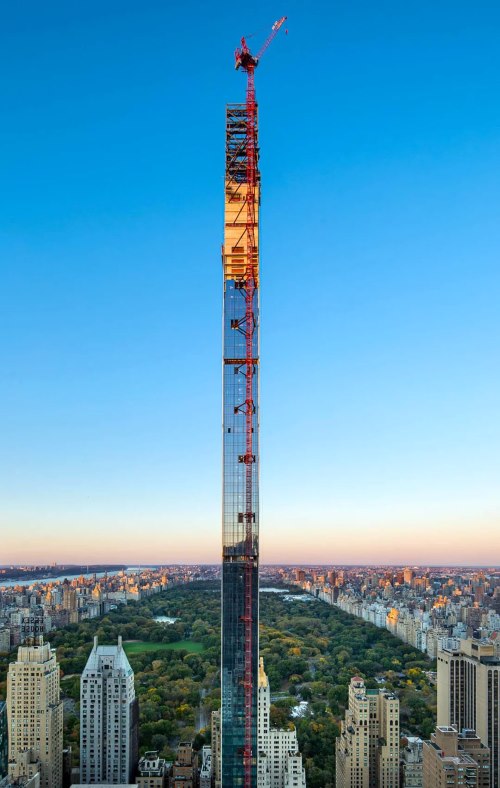
The building structurally topped out in April 2019, after which construction began on the decorative steel crown.
Steinway Tower under construction in 2019
In October 2019, components at the top of the crown were installed, bringing the tower to its official architectural height of 1,428 feet (435 meters).
By the end of 2021, the exterior curtain wall was completed, giving the building a finished appearance.
In April 2022, the developer officially announced the completion of the tower. Total construction costs reached approximately $2 billion.






You must be logged in to post a comment.